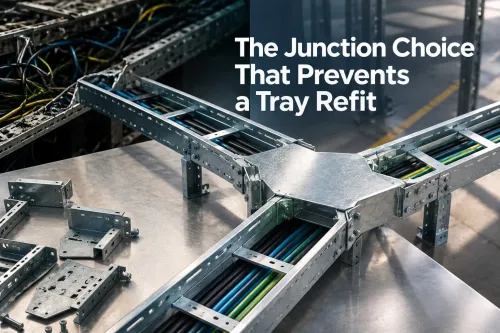
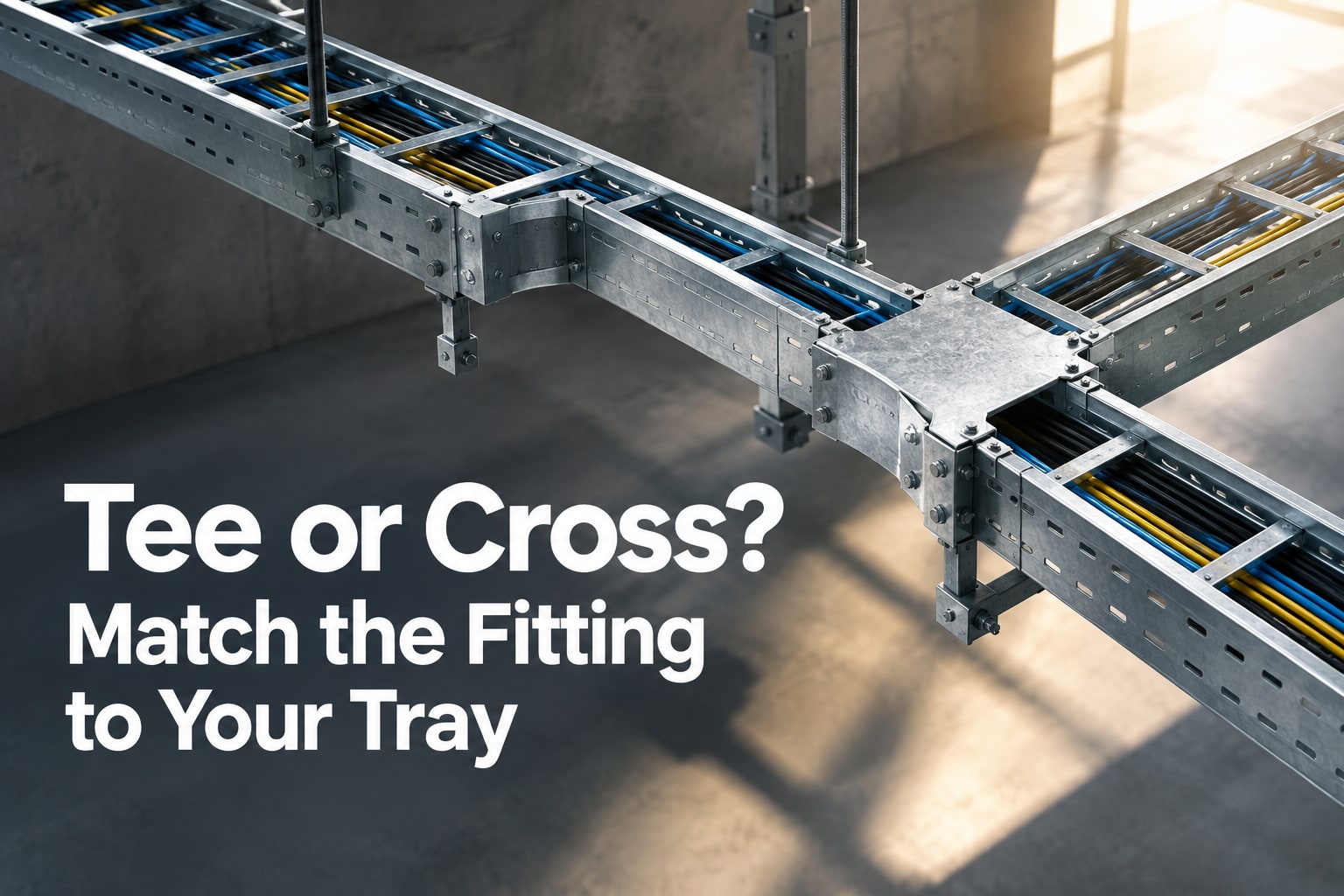
A horizontal tee gives one ladder-tray route a single branch, while a horizontal cross creates four connected directions at one level. By the end, you will be able to identify the correct fitting, check whether it matches your tray, and specify the support, cable-clearance and compliance details that prevent installation problems.
Key takeaways
- A horizontal tee provides three route openings; a cross provides four.
- Match fitting width, rail height, rung spacing, and finish to the ladder tray.
- Use route direction and cable loading to size each branch correctly.
- Specify dimensions, material, finish, and joint details before requesting a quotation.
How a horizontal tee differs from a horizontal cross
A horizontal tee creates three route openings; a horizontal cross creates four. The search phrase what is a cable tray ladder horizontal cross tee in delhi can blur the distinction, but “cross” is the clearer technical term for the four-way fitting.
| Fitting | Route arrangement | Correct use |
|---|---|---|
| Horizontal tee | One route enters, continues straight, and one branch leaves, normally at 90 degrees | One main route feeding one branch |
| Horizontal cross | Two opposite openings form the straight-through route; two side openings create additional branches | An intersection where two routes continue and two more leave |
| Vertical fitting | Changes elevation or transitions between horizontal and vertical paths | A rising, dropping, vertical tee, vertical cross, reducer or transition |
Neither horizontal fitting rises or drops. Both change direction in the plan view while keeping the connected tray routes at the same elevation. A cross used for one branch adds an unused opening, extra material and a less clear path for separating power, control or instrumentation cables.
“Horizontal” describes the route geometry, while “ladder” describes construction: two longitudinal side rails joined by transverse rungs. The fitting must preserve that ladder form at every entry and exit, including matching rail profiles, rung spacing and joining points. Choose a tee for one branch; choose a cross for two continuing directions plus two branches.
How to match the fitting to the ladder tray
A 300 mm cable tray horizontal tee is not a universal fit: nominal width does not prove that its rails and joint will mate with a 300 mm ladder tray. Select the fitting by tray width and side-rail height, then compare the tray series, rail profile, material thickness, rung shape and rung spacing.
| Check | Compare | Why it matters |
|---|---|---|
| Width and height | Fitting dimensions with straight-tray dimensions | A mismatch leaves steps, gaps or stressed joints |
| Rail and rung design | Side-rail section, rung profile and spacing | Different sections cannot carry or protect cables as one system |
| Connection | Splice plates, bolt-hole pattern and joining method | Bolted plates, integral flanges and clamps are not interchangeable |
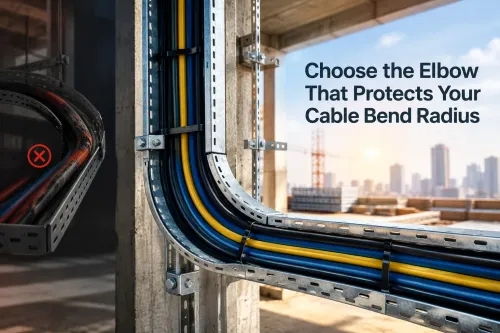
| Bend geometry | Fitting inside radius with the cable manufacturer’s minimum bending radius | The tray radius alone does not prove a safe cable route |
| Finish | Continuous galvanized sheet or hot-dip galvanizing after fabrication | The processes differ at cut edges, welds, coating thickness and repair areas |
Inspect the fitting against an actual straight section before ordering. Confirm the branch angle, connection pattern and whether the joint uses the manufacturer’s specified hardware; a hole pattern that is only slightly different can force drilling or misalignment.
Write the finish precisely instead of using “GI”. For a cable tray ladder horizontal tee in Delhi, record tray width, rail height, material, thickness, finish, angle, connection pattern and overall delivery dimensions on the purchase specification. Include drawings when the fitting is non-standard.
How cable routing and load change the selection
The fitting is suitable only when it protects cable geometry and carries the combined load at the intersection; nominal tray width proves neither. Route power, control, instrumentation, fibre-optic and screened cables without reducing any cable below its manufacturer’s minimum bending radius.
| Routing condition | Selection implication | Check before approval |
|---|---|---|
| One main route and one branch | A tee normally provides the required path | Keep the branch opening clear for pulling and termination |
| Two routes continue and two branch routes leave | A cable tray horizontal cross suits the four-way intersection | Confirm clearance for inspection and planned additions |
| Any cable with a specified bend limit | Choose geometry around the cable, not the tray label | A fitting radius is not automatically a safe cable radius |
Do not fill the intersection so tightly that the nominal width becomes misleading. Crowding restricts pulling space, hides joints and leaves no room for later cables.
Calculate the combined load from cable weights and planned fill, then compare it with the fitting’s stated allowable load at the proposed support span. Do not transfer the straight-tray rating to a tee or cross without confirmation.
- Support cables so their weight does not hang from one rung edge, splice plate or unsupported branch.
- Add a support close to the fitting when the manufacturer’s load table requires it or a long branch leaves the intersection.
- Check deflection as well as ultimate load, and retain spare capacity for specified future additions.
Why a factory-made fitting is different from a site-cut joint
A factory-made tee or cross is preferable when the intersection must fit the ladder tray without improvised alignment. It provides defined branch geometry, a matching rail profile and a tested connection pattern, while removing several cut edges that can snag cable jackets during pulling.
Site fabrication works only when the design permits it and the installer preserves the tray’s load path, cable bending space and corrosion protection. Remove sharp projections, protect every cut or drilled area, and reject a joint that twists the branch, puts bolt holes under strain or creates a cable-catching step.
1. Set out the straight runs and mark the branch direction before fixing the fitting.
2. Place supports at the fitting locations required by the manufacturer’s load table. Do not assume the straight tray’s span or load rating applies to the tee or cross.
3. Join each section with the specified splice plates, bolts, clamps or other hardware. Tighten the connection without forcing misaligned holes together.
4. Inspect the completed path for steps, sharp edges, branch movement and adequate space for pulling, termination and maintenance before installing cables.
5. Verify electrical continuity across every joint when the tray forms a protective bonding path. Painted, heavily coated or poorly tightened interfaces may require bonding jumpers or another specified bonding measure.
Treat the fitting as one part of the installation, not the finished route. Keep cable weight off a single rung edge, splice plate or unsupported branch, and leave access for future work.
What to specify when buying a tee or cross in Delhi
A purchase request must name the fitting and its interface, not merely the city where it will be supplied. “Cable tray ladder horizontal cross in delhi” and “cable tray ladder horizontal tee in delhi” are commercial search terms; Delhi identifies the supply location, not a technical classification.
| Fitting | Route geometry | Specify |
|---|---|---|
| Three-way horizontal tee | One straight-through route plus one 90-degree branch | Connecting tray width and side-rail height |
| Four-way horizontal cross | Two straight-through directions plus two 90-degree branch directions | Connecting tray width and side-rail height |
State the material, thickness, finish, branch angle, splice pattern, support span and required load. Also give the tray series, delivery dimensions and connection details. A matching nominal width alone does not prove compatibility.
Ask for these documents before approving the fitting:
- Fitting drawing and dimensions
- Fitting load table and allowable support spacing
- Material or coating declaration
- Installation instructions
- Available test or compliance documents
Ask the project engineer which standard and edition governs tray construction, earthing or bonding, fire performance and load testing. Do not infer compliance from the fitting’s shape, and do not assume IS 8623 or IEC 61537 applies unchanged without checking project documents and authority requirements.
D And D Metal can review a made-to-specification request when you provide tray dimensions, connection details, cable loading and finish requirements.
Related products
 | cable tray Cable Tray Ladder Horizontal Cross A cable tray ladder horizontal cross is a type of cable management system that allows for the intersection of horizontal runs of cable trays. View product → |
 | Ladder cable tray Cable Tray Ladder Horizontal Tee A cable tray ladder horizontal tee is a structural component used in cable management systems. View product → |
Frequently asked questions
How does a horizontal tee differ from a horizontal cross?
A cable tray horizontal tee creates three route openings: one incoming route and two branches. A horizontal cross creates four openings and splits the route into three branches or connects four directions.
How do you match a fitting to the ladder tray?
Match the tray width, side-rail height, rung spacing, material, surface finish, and connection pattern. Confirm that the fitting maintains the tray’s clear cable space and accepts the same splice plates or connectors.
How do cable routing and load change the selection?
Choose a tee when the route divides into two branches and a cross when it divides into three or connects four directions. Check the cable fill, bend radius, branch loading, support spacing, and fitting load rating before ordering.
Why is a factory-made fitting different from a site-cut joint?
A factory-made fitting provides controlled geometry, formed edges, consistent hole positions, and a specified finish. A site-cut joint takes more installation time and can leave sharp edges, inaccurate alignment, exposed steel, or weaker connections.
What should you specify when buying a tee or cross in Delhi?
State the fitting type, tray width and height, material, finish, branch directions, splice method, cable load, support arrangement, quantity, delivery location, and required drawings or inspection documents.
Keywords