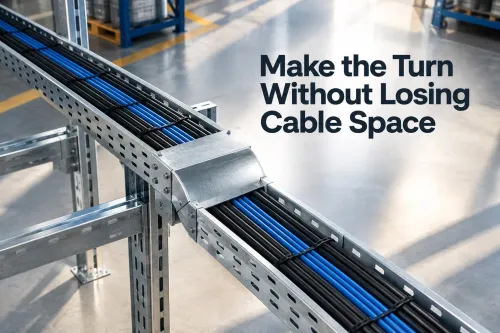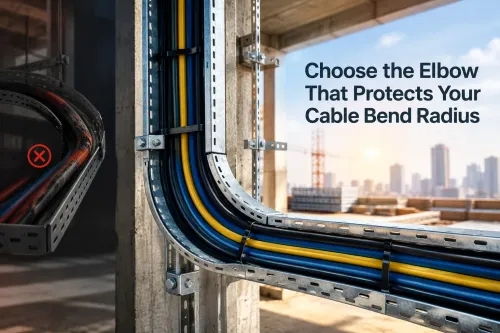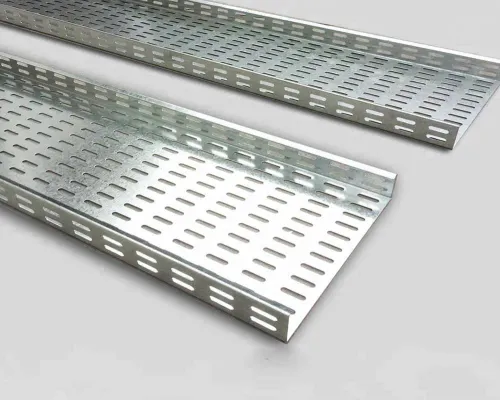

A quoted cable tray perforated reducer is usually a fabricated supply item, not a complete installation service. You will be able to determine what the price covers, specify the correct transition, and request labour, accessories, delivery, and inspection as separate written scope items.
Key takeaways
- Treat the reducer price as material supply unless installation is listed separately.
- Ask whether labour, supports, cutting, lifting, and testing are included.
- State both tray widths, side-rail height, hand, and orientation before ordering.
- Compare Delhi quotations using identical dimensions and clearly separated supply and installation costs.
The reducer price usually covers the fitting, not the site work
Budget a cable tray perforated reducer as a material-supply item, not site work. The fitting normally changes width only, such as 600 mm to 300 mm; it does not automatically change side-rail height, elevation, or cable routing.
Installation is included only when the quotation, purchase order, or bill of quantities expressly says “supply and installation” and defines the work.
| Quotation wording | What it means | Your action |
|---|---|---|
| “Supply only” | Fabricated reducer only | Price site work separately |
| “Ex-works” or “material only” | Goods supplied from the stated premises | Arrange transport, unloading, and installation |
| “Installation by others” | Supplier excludes site labour | Appoint and coordinate an installer |
| “Supply and installation” | Installation is included only within the written scope | Check every inclusion and exclusion |
Ask whether the price includes delivery, unloading, site measurement, labour, lifting, splice plates, bolts, nuts, washers, bonding jumpers, supports, covers, touch-up coating, inspection, testing, and cable securing. “Free delivery” does not mean free installation, and a local supplier does not automatically provide site labour.
Request separate prices for the fabricated reducer, accessories, transport, installation, testing, and any shutdown, permit, restricted access, or lifting requirement. The document should state the incoming and outgoing tray widths, side-rail height, quantity, finish, and installation boundary. If it does not, treat the price as supply only and ask for a corrected commercial scope.
How to read a quotation for supply, installation, and responsibility
A quotation is complete only when it assigns each task to a named party. Treat “reducer” alone as a product description, not proof that labour, delivery, or site work is included.
1. Check the item line by line. It should state the tray system, concentric or offset geometry, quantity, incoming and outgoing widths, material, thickness, finish, and whether the rate says “supply only” or “supply and installation.” A cable tray reducer supplier in Delhi should also identify the delivery point and quotation validity.
2. Read the exclusions before comparing rates. Look specifically for site measurement, drawing approval, scaffolding or lifting, support steel, clamps, splice plates, bolts, nuts, washers, bonding or earthing, testing, delivery access, debris removal, touch-up coating, and rework caused by incorrect dimensions.
“Installation by others” leaves these risks with you unless the purchase order changes that wording.
3. Allocate each site responsibility in writing. Name who will measure the existing tray, confirm the large and small ends, align and fasten the fitting, inspect the joint, check edge protection, bond the connection, and secure cables after the transition.
Ask whether labour covers normal working hours or adds charges for a shutdown, permit, night work, lifting, or restricted access.
4. Put the agreed boundary in the purchase order, including drawings and approved dimensions. Do not rely on a verbal promise. If the supplier will not confirm installation responsibility in writing, budget for material supply only and appoint an installer separately.
Specify the dimensions, hand, and orientation before ordering
Physical fit depends on the existing tray profile, not the word “reducer.” Record the incoming wide-tray width, outgoing narrow-tray width, both side-rail heights, and usable inside space; for example, 600 mm to 300 mm is incomplete without those heights and clear internal dimensions.
Include these details in the enquiry:
- Material, coating, thickness, perforation pattern, and joint-hole pattern
- Confirmation that the fitting belongs to the same perforated tray system
- Large end, small end, direction of cable travel, and installation position
- Horizontal, vertical upward, or vertical downward orientation
- A drawing or photograph showing adjacent tray, supports, equipment, and cable-entry space
Equal nominal widths do not guarantee matching side-rail profiles or bolt holes. A mixed system can leave the splice holes misaligned, weaken the joint, or interrupt electrical continuity.
| Geometry | Physical result | Select it when |
|---|---|---|
| Concentric | Both tray edges change position | The centreline must remain aligned |
| Left-hand offset | The left edge remains aligned | You need cable-bending space or must avoid equipment on the left |
| Right-hand offset | The right edge remains aligned | You need cable-bending space or must avoid equipment on the right |
Check the largest cable’s minimum bending radius against the reducer’s usable space before approval. A cable tray size transition that is too abrupt can trap or kink cables; use a straight tray run, staged transition, or different fitting instead of forcing the bend.
Perforated tray fittings also require the manufacturer’s compatible joining method. Do not approve fabrication until the dimensions, hand, orientation, hole alignment, and cable-entry clearance appear on the drawing.
What installation work happens at the transition
The installer measures the existing tray before fixing anything, confirms the large-end and small-end widths, and sets the reducer in the specified direction. A wrong width or reversed hand can leave joint holes misaligned and force cables against the transition.
Use this installation checklist:
- Align both side rails and joint holes, then fasten the reducer with the specified splice plates, bolts, nuts, and washers.
- Inspect every cut and edge for exposed metal. Remove sharp projections and add approved edge protection where cables could rub.
- Secure cables on both sides so their weight does not load the reducer joint and no cable becomes trapped in the narrower section.
- Verify supports near the reducer against the selected system’s fitting ratings, support guidance, and project specification. Do not apply a generic spacing value: the transition can increase loading, pulling tension, or the risk of a cantilevered joint.
- Check cable fill, heat dissipation, and minimum bending clearance in the narrow section, with particular care for grouped power cables and single-core AC cables.
- Test electrical continuity across painted or galvanised joints. Install bonding jumpers when the project earthing design requires them; mechanical bolts alone do not prove continuity.
- Record the inspection and identify whether IEC 61537, NEMA VE 1, or an Indian project specification governs the work. Claim compliance only when the selected system and project documents verify it.
The reducer’s load capacity does not automatically equal the straight tray’s rating. Finish, thickness, splice position, support arrangement, and transition direction can change the allowable load, so obtain the manufacturer’s fitting data before loading the tray.
Use a precise enquiry when comparing Delhi suppliers
Send every Delhi supplier the same written enquiry. A search for “cable tray perforated for reducer in delhi” or “cable tray reducer supplier in delhi” can help locate delivery and site-visit options, but location proves neither physical fit nor installation inclusion.
1. “Quote one [horizontal/vertical] [concentric/left-hand/right-hand] perforated reducer from [wide width] to [narrow width], with [side-rail height], [material], [finish], [thickness], and matching [hole pattern]. Include [splice plates, bolts, nuts, washers, bonding jumpers, covers, supports], delivery to [site], installation, inspection, testing, and cable securing.”
2. Add the quantity, installation elevation, cable type, largest cable bend radius, support method, drawing reference, required project standard, delivery access, and whether site measurement is required. State both incoming and outgoing tray sizes; a reducer changes width, not automatically tray height or elevation.
3. Ask for the reducer drawing, product data, manufacturer load information, warranty terms, lead time, and a written list of exclusions. Require separate confirmation for support steel, clamps, lifting, touch-up coating, shutdowns, restricted access, and bonding work.
4. Treat installation as included only when the quotation, purchase order, or bill of quantities says “supply and installation” and defines the work. D And D Metal can be one supplier to approach for that project-specific quotation, but compare its written scope against your drawings before ordering.
Related product
 | Perforated type cable tray A cable tray perforated reducer is a fitting used in cable management systems. View product → |
Frequently asked questions
Does a cable tray perforated reducer include installation?
Usually, the price covers the reducer fitting only. Labour and site work are included only when the quotation expressly lists installation.
What should a quotation show for a cable tray reducer?
Check for separate lines covering the fitting, delivery, labour, supports, cutting, lifting, fasteners, testing, taxes, and responsibility for site measurements.
What dimensions must you specify before ordering?
State the incoming and outgoing tray widths, side-rail height, reducer hand, and horizontal or vertical orientation.
What installation work happens at a cable tray size transition?
Installers align and support both tray sections, fit the reducer, secure fasteners, manage the cable bend, and check clearance and continuity.
How should you compare cable tray reducer suppliers in Delhi?
Send every supplier the same written dimensions, material and finish requirements, quantity, delivery location, and supply-versus-installation scope.
Keywords