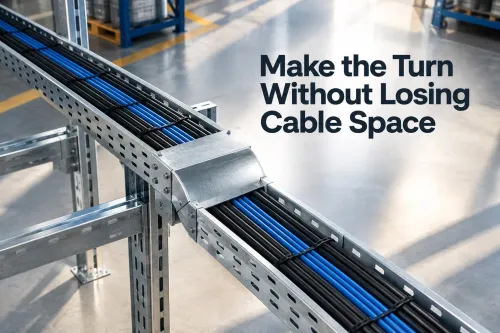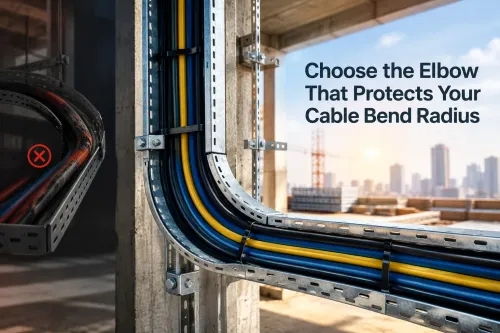

A nominal 600 mm-to-450 mm reducer is not a complete buying specification: the transition also needs a defined orientation, radius, rail profile, connection pattern, material, finish, and load basis. By the end, you will be able to write a usable RFQ, compare Delhi and NCR supply routes, verify compatibility, and approve the fitting for installation without relying on a unit price alone.
Key takeaways
- State both tray widths, rail height, geometry, thickness, grade, and finish in the RFQ.
- Send tray drawings, rung spacing, joint details, and dimensions to confirm compatibility.
- Compare manufacturers, stockists, and NCR fabricators by delivery, testing, and installation support.
- Inspect bend radius, edge protection, fasteners, coating, and cable clearance after installation.
Write a reducer RFQ that suppliers can price accurately
A ladder cable tray reducer supplier in Delhi needs more than the two tray widths to price the fitting. State the entering width, exiting width, side-rail height, overall fitting length, taper or bend geometry, material thickness, steel grade, and finish.
1. Identify the configuration as horizontal or vertical, then specify concentric, offset, left-hand, or right-hand. A concentric reducer keeps the cable route centred between both rails. An offset reducer keeps one rail aligned with a wall, rack, shaft, or equipment entry. Left-hand and right-hand define the direction when viewed from the entering tray.
2. State the bend radius, transition angle, rung spacing, splice-plate arrangement, bolt-hole pattern, and whether the reducer must match an existing tray system. Include cover requirements and any dimensional drawing reference.
3. Request separate prices for the formed reducer, splice plates, bolts, bonding links, covers, packing, and delivery. Ask for the proposed drawing before fabrication.
Use wording such as: “Supply one 600 mm-to-450 mm horizontal, concentric ladder reducer; 300 mm bend radius; 100 mm side rails; 2.0 mm galvanized steel; splice plates and bolts to match the existing tray; hot-dip galvanized finish after fabrication.”
“600-to-300 ladder reducer” is incomplete. It leaves out handedness, length, radius, rail height, thickness, steel grade, finish, and connection details—the information that determines whether the supplier can fabricate the correct part.
Confirm that the reducer will join the existing tray system
Do not approve a reducer until its connection dimensions match the installed tray at both ends. Nominal width alone proves little: two manufacturers can label a tray 600 mm wide while using different outside-width tolerances, rail shapes, rung positions, and drilling.
For a ladder type cable tray reducer in Delhi, compare this physical checklist against the existing run:
- Side-rail profile and height
- Rung spacing and rung attachment
- Actual tray width and permitted tolerance
- Splice-plate position at each end
- Bolt-hole diameter, spacing, and pattern
- Joining hardware, including nut type and bolt length
- Left-hand or right-hand orientation
Request a dimensioned drawing showing both reducer ends, the taper or bend, overall length, rail height, hole centres, and orientation. Confirm that matching splice plates, bolts, bonding links, and covers are available; a fitting that reaches the tray but lacks compatible joining parts is not interchangeable.
| Fitting type | Identifying condition | Buying decision |
|---|---|---|
| Standard system fitting | Radius, angle, length, width change, and hole pattern match the manufacturer’s catalogue system | Approve against the drawing and hardware schedule |
| Made-to-order transition | Any radius, angle, length, rail height, or hole pattern is non-standard | Require drawing approval before fabrication |
If the existing tray uses a different rail profile or drilling system, specify a made-to-order transition rather than forcing holes on site. A verbal request such as “600-to-300 reducer” omits the dimensions that determine whether the joint will fit.
Compare Delhi manufacturers, stockists, and NCR fabricators on total supply
Compare three sources before accepting the lowest unit price. A ladder cable tray fitting manufacturer in Delhi offers system-specific fabrication; a stockist holds standard fittings for rapid dispatch; a nearby fabricator can produce a non-standard reducer from an approved drawing. A cable tray reducer supplier near Delhi still needs dimensional and hardware verification.
| Option | Advantage | Main risk |
|---|---|---|
| Local manufacturer | Exact system matching and drawing control | Manufacturing lead time or minimum order |
| Stockist | Fast availability and established packing | Standard dimensions may not match your tray |
| NCR fabricator | Flexible length, angle, and hole pattern | Requires drawing approval and finish inspection |
Ask every source for:
- Manufacturing or dispatch lead time, minimum order quantity, Delhi delivery coverage, packing method, drawing-approval timing, and replacement policy.
- Confirmation that the reducer matches the existing rail profile, side-rail height, splice-hole pattern, and joining hardware.
A stock reducer saves time, but field-cutting and modifying straight tray adds burr removal, galvanizing repair, alignment work, and uncertain strength. A custom-fabricated transition gives exact geometry; a perforated reducer may improve flexibility but can reduce rigidity and leave compatibility questions. Choose stock only when its drawing matches the installed system.
Require separate prices for the formed fitting, splice plates, bolts, earthing or bonding jumpers, covers, support steel, galvanizing repair, packing, and transport. Compare total installed supply, not the headline reducer price.
Qualify the supplier with load, finish, and compliance evidence
A quotation becomes an engineering comparison only when the supplier provides a dimensioned drawing, material and thickness specification, finish route, load/span table, support-spacing limits, allowable deflection criterion, and the reducer’s own test basis. A fitting rating cannot be inferred from a straight-tray rating: joints, cut geometry, and the resulting effective span change the load path.
Before approval, request:
- Design load in kN/m or kg/m, stated with the support spacing and deflection limit.
- The claimed standard, either IEC 61537 or NEMA VE 1, plus the exact tested configuration and complete test report. Reject “IEC tested” without those details.
- For galvanized steel, confirmation of hot-dip galvanizing after fabrication or pre-galvanized sheet, the cut-edge repair coating, coating thickness or repair method, and inspection record.
| Evidence | What to compare | What failure reveals |
|---|---|---|
| Dimensioned drawing | Widths, rail profile, holes, joints and geometry | The offered reducer may not fit |
| Load/span table | Load, support spacing and deflection criterion | Thickness alone proves nothing |
| Finish record | Galvanizing route, repairs and inspection | Cut edges may corrode |
| Test report | Standard, configuration and results | Compliance is unverified |
Outdoor Delhi sites need a finish and hardware selection that addresses moisture and industrial contaminants. Specify compatible fasteners or isolation washers where galvanized steel touches dissimilar metal, or galvanic corrosion can develop at the joint.
Assess a ladder cable tray fitting manufacturer in Delhi, including D And D Metal, against this same drawing, finish, load, and test-document checklist rather than proximity or unit price.
Related product
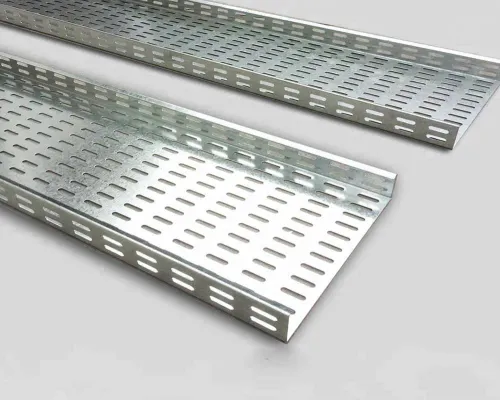
 | cable tray A cable tray ladder reducer is a component used in electrical and networking installations to transition between different sizes of cable trays. View product → |
Install and inspect the transition without creating a cable problem
Whether your source is a ladder cable tray reducer supplier in Delhi or a cable tray reducer supplier near Delhi, install from the approved drawing, not from nominal widths alone.
1. Install and level the supports for both tray sections. Confirm the supported span matches the supplier’s load/span instruction before placing the transition.
2. Place the reducer between the sections. Align the side-rail profiles, rail heights, and splice holes; then fit the specified splice plates and fasteners. Tighten each joint to the supplier’s stated instruction.
3. Remove burrs from every cut or drilled edge. Fit edge protection or another approved guard wherever cable insulation could contact sharp metal. Confirm bonding continuity across the reducer and joints where the installation requires it.
4. Before pulling cables, check each cable’s cross-sectional area and the manufacturer’s minimum bend radius on both sides of the transition. Do not force a large cable into the narrow end, compress parallel cables into the reduced width, or let cables cross at a pinch point.
5. After loading, recheck the supported span, cable weight, reducer location, deflection, and the final bend radius. A mechanically secure fitting can still damage insulation if loading changes the route or bend.
Record the approved drawing, delivered dimensions, finish condition, and every site repair, including galvanizing repair, in the handover file. Photograph concealed joints before cable installation.
Frequently asked questions
What information should a reducer RFQ include?
Include entering and exiting widths, side-rail height, overall length, taper or bend geometry, material thickness, steel grade, finish, quantity, and delivery location. Attach tray drawings and joint details.
How do you confirm a reducer will join an existing ladder tray system?
Compare the reducer’s width, rail height, rung spacing, connector-hole pattern, joint plates, fasteners, and finish with the installed tray. Request a dimensioned drawing before fabrication.
How should Delhi cable tray reducer suppliers be compared?
Compare Delhi manufacturers, stockists, and NCR fabricators on dimensional control, material evidence, coating process, delivery time, packing, replacement terms, and installation support rather than price alone.
What evidence should you request from a reducer supplier?
Request load information, steel grade or material certificates, coating details, thickness records, inspection reports, drawings, and any declared compliance documents relevant to the project.
What should you inspect after installing a ladder tray reducer?
Check alignment, joint tightness, sharp edges, coating damage, support spacing, cable bend radius, fill clearance, separation, and movement points before pulling cables.
Keywords