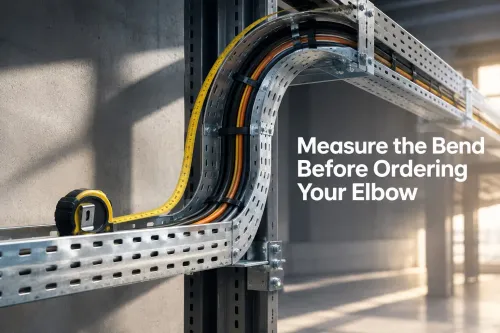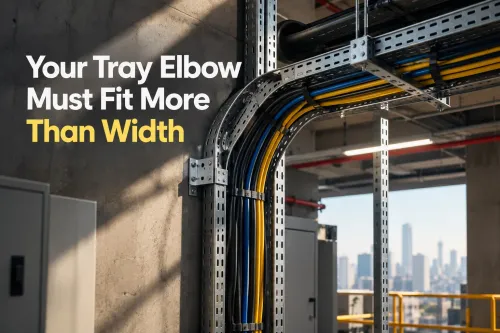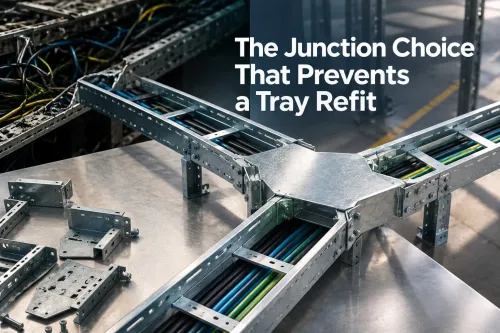
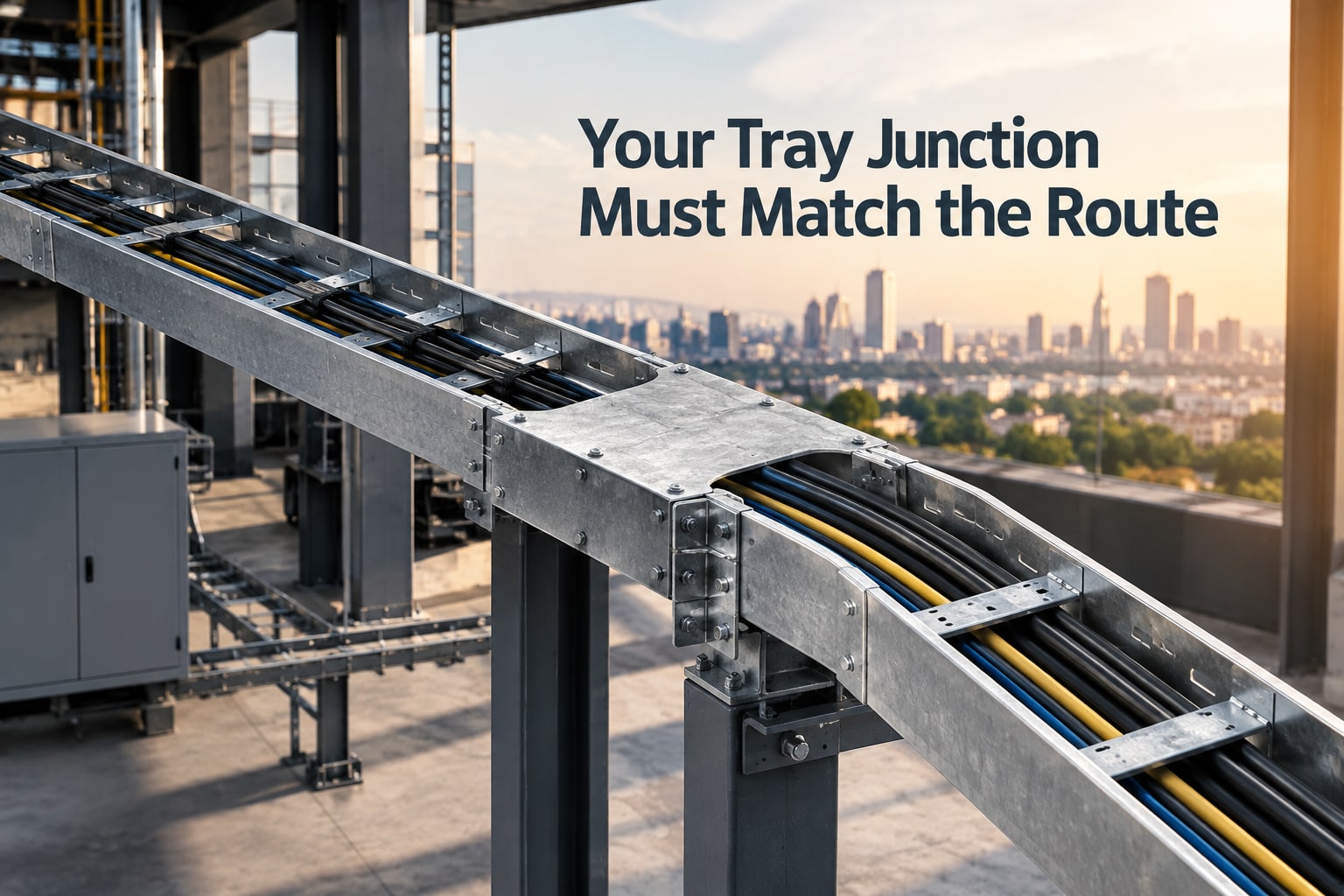
Choose a horizontal tee when one tray run branches into two directions, and choose a horizontal cross when two opposing branches are required at the same junction. The correct decision also depends on tray geometry, usable cable space, bend radius, loading, finish, and compatibility with the installed ladder tray—not the fitting name alone.
Key takeaways
- Use a tee for one 90-degree branch and a cross for two opposing branches.
- Draw the route in plan view before selecting a horizontal fitting.
- Confirm tray width, rail height, rung spacing, and bend-radius clearance.
- Specify dimensions, material, finish, and inspection documents in the purchase order.
When a horizontal tee is the right junction
Choose a horizontal tee when the plan shows one branch leaving the main route at 90 degrees. Choose a horizontal cross when two opposing branches leave that intersection. For a cable tray ladder horizontal tee or cross in Delhi, do not order from the word “tee” alone; the drawing must define the route geometry.
| Fitting | Plan-view geometry | Use it when |
|---|---|---|
| Horizontal tee | Incoming run, continuing outgoing run, and one 90-degree branch | One branch route leaves the main tray |
| Horizontal cross | Incoming run, continuing outgoing run, and two opposing branches | Two branch routes leave opposite sides |
| Unused direction | No connected tray run shown | Close, cap, or omit that direction as the design requires |
Mark the incoming run, outgoing run, branch direction, and any unused direction on the plan before requesting a price. A cross is not a tee with extra metal; its fourth opening affects cable entry, support, bend space, and future routing.
- Match the fitting to the parent tray’s width, side-rail height, rung pattern, material thickness, and side-rail profile.
- Confirm the splice-plate design, bolt pattern, and joining hardware. A nominal 300 mm or 600 mm width does not prove compatibility.
- State horizontal orientation; do not substitute an inside vertical or outside vertical fitting.
- For a ladder cable tray tee in Delhi, specify the bend radius, coating, material grade, and applicable project standard alongside the branch direction.
Read the junction as a plan-view routing problem
Draw the junction as a plan view before selecting any horizontal cable tray fittings. A ladder-tray horizontal tee shows three usable directions: one incoming run and two outgoing paths, with one branch at 90 degrees. A horizontal cross shows four: one incoming run, one continuing run, and two opposing branches.
1. Draw the incoming tray as a solid line with an arrow showing cable travel. Label its nominal width, side-rail height, and elevation.
2. Draw every intended outgoing route from the junction. Mark the straight continuation, the 90-degree branch, and the second opposing branch where a cross is required. Add each route’s width, destination, cable service, and required bend direction.
3. Mark unused directions clearly as “no tray” or “future provision.” Do not leave an empty arm implied; an unmarked direction can become an incorrect cross, an obstructed access route, or an unsupported tray end.
4. Write “horizontal” beside the fitting and identify the plan-view orientation. Do not substitute an inside vertical tee or outside vertical tee: its cable bend, support arrangement, and internal radius differ.
5. Check each outgoing path separately for cable fill, segregation, spare capacity, and clearance. Confirm that the fitting’s inside radius meets the largest cable manufacturer’s minimum bending radius; matching tray width alone proves nothing.
Attach this marked-up plan to the order, with the tee or cross geometry and branch direction named.
Match the fitting to the actual ladder-tray profile
A nominal 300 mm or 600 mm width does not prove that a fitting will join your tray. Measure the installed ladder profile and match the tee or cross to its side-rail shape, rung arrangement, joining method, and usable internal dimensions.
Check these details against the parent tray drawing or a physical sample:
- Clear tray width, side-rail height, rail thickness, and rung spacing
- Side-rail section, including folded lips, perforations, flanges, and corner geometry
- Rung shape, diameter or section, welding method, and attachment position
- Material grade, sheet thickness, and finish, such as pre-galvanized steel or post-fabrication hot-dip galvanizing
- Splice-plate hole pattern, bolt size, overlap length, and compatible bonding hardware
- Horizontal orientation and inside bend radius, not a vertical bend or vertical tee
| Fitting | Mechanical form to verify | Common mismatch |
|---|---|---|
| Tee | Three aligned tray directions, one 90-degree branch, matching rail and splice details on each arm | Branch rail profile or hole pattern differs from the straight tray |
| Cross | Four tray directions, two opposing branches, matching dimensions on all four arms | One branch uses a different width, height, or joining system |
For a ladder cable tray cross in Delhi, put the measured width, rail height, thickness, radius, and branch directions on the purchase line. “Horizontal cable tray fittings” is too broad unless it also names the ladder construction, finish, and splice system.
A fitting that shares the width but not the rail profile will need site drilling, forced alignment, or an unsafe improvised joint.
Size cable space, bend radius, and support at the junction
A tee or cross must carry the cable load without turning the junction into a bottleneck. Check fill separately for the incoming run and every outgoing path using cable outside diameters, required spare capacity, installation clearance, and the project specification; tray width alone does not establish capacity.
Keep power, control, instrumentation, and communication cables in their specified segregated zones. If a branch changes the separation arrangement, select a fitting with the required divider, or provide separate tray routes. A nominal 300 mm ladder tray does not automatically provide 300 mm of usable space at its tee.
The inside radius must meet the minimum bending radius marked by the largest cable manufacturer. A fitting can match the parent tray width and still kink a power cable at the branch. Do not substitute a vertical bend or vertical tee: its cable direction, usable radius, and support geometry differ from a horizontal fitting.
Cable weight determines the junction support arrangement. A heavily loaded cross needs support for each continuing direction, while a lightly loaded tee may follow the manufacturer’s standard span only when the fitting is not left cantilevered.
Confirm the support spacing and load rating against the actual cable mass, then place a support close enough to prevent twisting at the fitting.
For a purchase request, state:
- Cable tray ladder horizontal tee or cross in Delhi: horizontal orientation, branch geometry, width, side-rail height, and inside radius.
- Ladder cable tray tee in Delhi: cable fill, segregation, cable load, and support points for each route.
- Ladder cable tray cross in Delhi: the same checks for all four directions, including any unused opening and its closure method.
Write a Delhi purchase specification that can be checked
Put the fitting on the purchase order as a checkable line item, not as “horizontal cable tray fittings.” Tell the cable tray tee supplier in Delhi which run is the incoming path, which is the branch, and whether you need a three-way tee or four-way cross.
- State the finish: hot-dip galvanized after fabrication or pre-galvanized, the governing standard such as ISO 1461 or IS 4759, required zinc coating mass or thickness, surface preparation, and treatment of threaded or close-tolerance parts. “GI finish” alone is not comparable.
- State the geometry: tee or cross, branch direction, nominal width, side-rail height, bend radius, rung design, material grade, material thickness, and the exact parent-tray profile. A 300 mm or 600 mm width alone does not prove fit.
- State the joining method: splice-plate type, bolt size, compatible hardware, and whether the joint accepts the existing tray’s splice system. Ask for a dimensioned fabrication drawing before approval.
- State bonding requirements: bonding-capable splice hardware or separate bonding jumpers, connection points, and the continuity test record required after installation. Zinc coating does not guarantee electrical continuity.
- Name the compliance basis: IEC 61537, NEMA VE 1, IS standard, or the project specification, including any load and deflection criteria that apply.
- Confirm delivery compatibility: promised dispatch date, packing that prevents coating damage, piece markings, certificates, and delivery in the sequence and lengths needed for the Delhi site.
D And D Metal should receive the same schedule, drawing, and inspection requirements if it is being evaluated for the cable tray ladder horizontal tee or cross in Delhi.
Frequently asked questions
When should you choose a horizontal tee instead of a cross?
Choose a horizontal tee when one branch leaves the main tray route at 90 degrees. Choose a horizontal cross when two opposing branches leave the same intersection.
How do you identify the correct ladder-tray fitting profile?
Match the fitting to the tray’s outside width, side-rail height, rung spacing, joining method, material, and finish. Do not order from the word “tee” or “cross” alone.
What must you check at a cable tray junction?
Check cable fill, bend-radius clearance, tray width, branch alignment, splice access, and support near the junction. The fitting must preserve the route and allow cables to turn without exceeding their minimum bend radius.
What should a Delhi purchase specification include?
State the fitting type, plan-view geometry, tray dimensions, material, galvanizing or coating requirement, connection hardware, quantity, drawing reference, tolerances, and inspection documents.
Keywords